
Why AI Starts With Your Data — Not Your Model
Updated: May 10
How a governed data foundation is the prerequisite for any meaningful AI initiative — and what organisations get wrong by skipping it.

There is a conversation happening in boardrooms, strategy sessions, and technology meetings across Australia right now. It sounds something like this.
We need an AI strategy. What model should we use? Should we build something or buy something? How quickly can we deploy it?
These are reasonable questions. But they are almost always the wrong questions to be asking first.
The organisations that are successfully deploying AI — using it to generate genuine business value rather than producing an impressive demonstration that quietly gets shelved six months later — share one thing in common. They invested in their data before they invested in their AI.
This guide explains why the quality, reliability, and governance of your data is the single most important factor in whether any AI initiative succeeds or fails — and what the organisations that get this wrong typically do instead.
The Uncomfortable Truth About AI
AI models are sophisticated. The engineering behind them is genuinely impressive. But at their core, AI models do one thing: they find patterns in data and use those patterns to make predictions or generate outputs.
The sophistication of the model matters. But it matters far less than most people assume. What matters far more is the quality, completeness, and consistency of the data the model is trained on and works with.
Put simply: a world-class AI model running on poor data will produce poor outputs. A more modest model running on clean, well-governed data will consistently outperform it.
This is not a fringe view. It is the consensus position of every serious AI practitioner. Garbage in, garbage out is a principle as old as computing — and it applies to AI more acutely than to almost anything else.
The uncomfortable implication is that for most mid-sized organisations, the work that needs to happen before any meaningful AI deployment is not about AI at all. It is about data.
What AI Actually Needs From Your Data
Understanding why data quality matters for AI requires understanding what AI actually does with data at each stage of its operation.
Training is where a model learns. It is exposed to large volumes of historical data and identifies patterns — relationships between inputs and outputs, correlations between variables, sequences that predict future events. If the training data is incomplete, inconsistent, or incorrectly labelled, the patterns the model learns will be wrong. And a model that has learned wrong patterns will apply them confidently to every new situation it encounters.
Inference is where a model makes predictions or generates outputs based on new data it has not seen before. The quality of inference depends on two things — the quality of the model's training, and the quality of the new data being fed to it. If your operational data is arriving late, being transformed inconsistently across systems, or contains errors that nobody has noticed, the model's outputs will reflect all of those problems.
Governance is where most organisations are least prepared. AI governance means being able to explain what a model did and why, demonstrate that the data it used was appropriate, audit its outputs for bias or error, and control who has access to its recommendations and how they are used. Without a governed data environment — with lineage tracking, access controls, and data quality validation — AI governance is impossible. You cannot govern what you cannot trace.
The Five Data Prerequisites for AI
Before any AI initiative can deliver reliable, trustworthy results, five data conditions need to be in place. Most mid-sized organisations have none of them fully addressed when they start thinking about AI deployment.
1. Data Completeness
AI models need complete data to learn from. Missing values, incomplete records, and gaps in historical data all degrade model performance — sometimes significantly. A payroll analytics model that is missing six months of contractor data will produce forecasts that systematically undercount workforce costs. A customer churn model trained on data that excludes a particular customer segment will fail to predict churn in that segment entirely.
Completeness requires reliable ingestion pipelines that capture all the data you need, from all the source systems that hold it, without gaps or failures. This is exactly the kind of foundation that a governed data platform provides — and exactly what most legacy ETL environments do not.
2. Data Consistency
Inconsistent data is one of the most common and most damaging problems AI initiatives encounter. When the same entity — a customer, an employee, a product — is represented differently across different systems, models that try to work across those systems will produce unreliable outputs.
A practical example: a workforce analytics company wanted to build a model predicting which contractors were at risk of leaving. Their contractor data existed in three systems — a CRM, a workforce management platform, and a payroll system — each representing the same contractors with different identifiers, different name formats, and different categorisation schemes. Before any AI work could begin, six weeks of data preparation was required just to create a single, consistent view of who the contractors actually were.
Consistency requires standardised data transformation — the Silver layer of the Medallion architecture — where data from different sources is cleaned, standardised, and reconciled before being made available for downstream use.
3. Data Lineage
AI governance requires knowing where your data came from, how it has been transformed, and what decisions it has been used to support. Without lineage tracking, you cannot demonstrate to a regulator, an auditor, or an affected individual that an AI decision was made on appropriate, accurate data.
In regulated industries — education, government, financial services, mining — this is not a nice-to-have. It is a legal and ethical obligation that is only going to become more stringent as AI governance frameworks mature.
Unity Catalog in Azure Databricks provides exactly this capability — a centralised record of data lineage across every dataset, pipeline, and transformation in the platform. Without it, AI governance relies on manual documentation that is inevitably incomplete.
4. Data Accessibility
AI initiatives fail when the data they need exists somewhere in the organisation but cannot be accessed in a usable form. Data locked in legacy systems, exported as flat files, or accessible only through manual processes cannot feed an AI model reliably.
A governed modern data platform — with standardised Gold-layer datasets published through controlled interfaces — makes data accessible to AI workloads in a consistent, governed, and reliable way. Legacy data environments, where data is scattered across proprietary formats and accessed through fragile point-to-point connections, cannot.
5. Data Timeliness
Many AI use cases depend on current data. A model predicting equipment failure needs sensor data from the last hour, not the last week. A model forecasting workforce demand needs yesterday's timesheet data, not last month's. A fraud detection model needs transaction data in near real-time.
Timeliness requires reliable, low-latency data pipelines — event-driven ingestion, incremental processing, and low-latency publishing to the Gold layer. Legacy batch ETL processes that run once a day cannot support the timeliness requirements of most modern AI use cases.
What Organisations Get Wrong
Given everything above, the pattern of what goes wrong in AI initiatives is predictable — and consistent across industries and organisation sizes.
They start with the model, not the data. The most common mistake. An organisation selects an AI platform, stands up a proof of concept, and discovers that the outputs are unreliable because the underlying data is incomplete, inconsistent, or inaccessible. The proof of concept is quietly shelved. Months of effort and significant investment produce nothing of value.
They treat data preparation as a project, not a practice. The second most common mistake. An organisation invests in a data cleanup exercise ahead of an AI initiative, produces a clean dataset for the initial model, and then watches the data quality erode over the following months as new data arrives through the same ungoverned pipelines that created the original problems. The model degrades. Trust in its outputs falls. The initiative loses momentum.
They underestimate the governance requirement. Organisations that successfully deploy an AI model often underestimate what is required to govern it responsibly over time. Who has access to its outputs? How are errors identified and corrected? How are its recommendations explained to the people affected by them? Without a governed data foundation — with lineage tracking, access controls, and data quality monitoring — these questions cannot be answered.
They skip the foundation to move faster. The pressure to demonstrate AI capability quickly is real. But organisations that skip the data foundation to accelerate deployment consistently end up slower in the long run — spending more time troubleshooting unreliable outputs, rebuilding data pipelines, and recovering from governance failures than they would have spent building the foundation properly in the first place.
What the Right Order Looks Like
The organisations that successfully deploy AI at scale follow a consistent sequence. It is not exciting. It does not make for a compelling press release. But it works.
First — establish the platform. A governed Lakehouse environment, provisioned through Infrastructure-as-Code, with a Catalog providing access control and lineage tracking. This is the foundation on which everything else is built.
Second — build reliable pipelines. Standardised ingestion from all relevant source systems, with Bronze, Silver, and Gold layers ensuring that data is progressively cleaned, standardised, and made available in a form that downstream consumers — including AI workloads — can trust.
Third — govern the data. Data quality rules, access controls, lineage tracking, and ownership assignment across all datasets. Not as a project that concludes — as an ongoing practice that evolves with the platform.
Fourth — build AI on top of it. With a clean, governed, reliable data foundation in place, AI workloads can be built on solid ground. Models trained on complete, consistent, well-governed data produce reliable outputs. Those outputs can be explained, audited, and trusted. And the platform that supports them can scale as the AI capability grows.
This sequence is not slow. In our experience, organisations that invest in the foundation first get to reliable AI capability faster than those that skip it — because they are not spending half their time troubleshooting data quality issues, rebuilding pipelines, or recovering from governance failures.
The Competitive Dimension
There is a strategic dimension to this that is worth naming directly.
The organisations that are investing in governed data platforms today are not just solving their current data problems. They are building the infrastructure on which AI capability will run for the next decade. The competitive gap between organisations with clean, governed data foundations and those without one is going to widen significantly as AI becomes more central to how businesses operate.
This is not a reason to panic. It is a reason to be deliberate. The organisations that will use AI most effectively in three years are not necessarily the ones deploying the most impressive AI tools today. They are the ones building the data foundations right now that will make those tools work reliably when they deploy them.
Where to Start
For most organisations, the most practical starting point is understanding the current state of your data environment — what data you have, where it lives, how reliable it is, and how well-governed it is — before making any decisions about AI deployment.
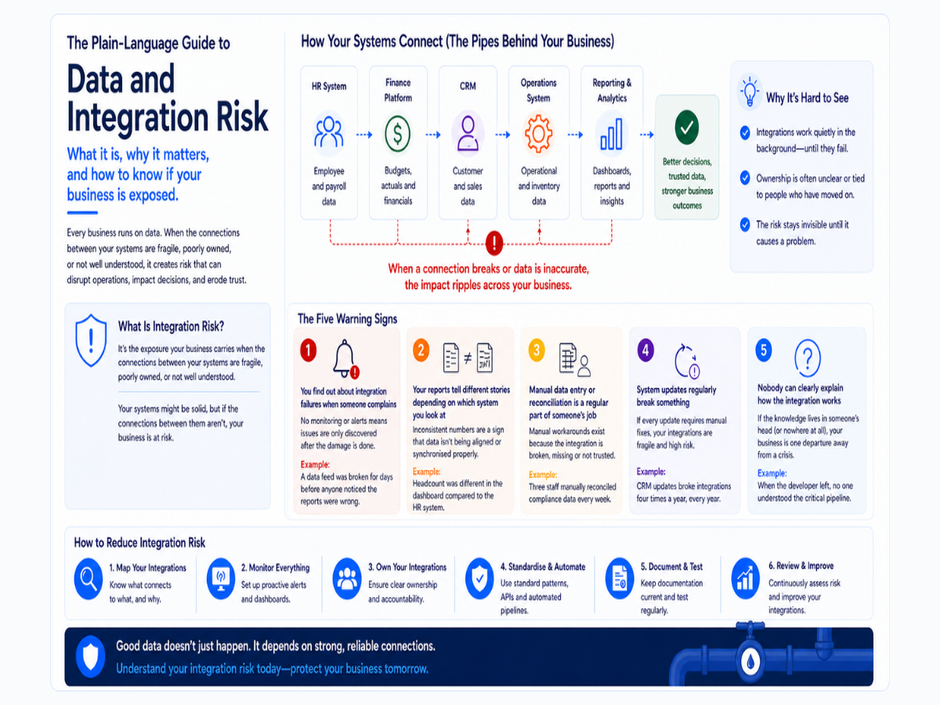
This is exactly what our Data and Integration Risk Assessment covers. Alongside integration reliability, pipeline health, and compliance exposure, the assessment includes an AI readiness dimension that gives your leadership team a clear, honest view of where your data environment currently sits relative to what AI deployment requires.
If your organisation is starting to think seriously about AI — or if you are already being asked about your AI strategy and are not sure how to answer — this is the most practical place to start.
Cypher Agency is a boutique data and integration engineering firm helping mid-sized Australian businesses build reliable, governed data and integration environments — without the cost of building an internal team.

Comments