
The Plain-Language Guide to Data and Integration Risk
Updated: May 10
What it is, why it matters, and how to know if your business is exposed.

Every business runs on data. And in most businesses, that data lives in more than one place.
Your payroll system talks to your finance platform. Your CRM pushes data to your reporting tool. Your customer database feeds your compliance reports. Your HR system connects to your workforce management platform. On a good day, all of those connections work quietly in the background, and nobody thinks about them.
On a bad day, one of them breaks.
Maybe payroll runs with last week's headcount because the HR sync failed overnight. Maybe the executive dashboard shows revenue figures that do not match the finance team's numbers because two systems are calculating the same metric differently. Maybe a compliance report goes out with missing data because a pipeline stopped running three days ago and nobody noticed.
These are not hypothetical scenarios. They happen in real organisations every week. And in most cases, the root cause is not a dramatic system failure — it is something much quieter and more insidious: integration risk that has been accumulating, unmanaged, for months or years.
This guide explains what integration risk actually is, what it looks like in practice, and how to know whether your organisation is exposed.
What Is Integration Risk?
Integration risk is the exposure your business carries when the connections between your systems are fragile, poorly owned, or not well understood.
It is not the same as the risk of your systems going down. Your ERP might be rock solid. Your HR platform might be perfectly maintained. But if the connection between them is held together with a script that one person wrote three years ago that nobody else understands, and that breaks every time either system releases an update — that is integration risk.
Think of your business systems like a set of pipes. Each pipe carries data from one system to another. Integration risk is what happens when those pipes are old, corroded, and nobody is quite sure where they all go.
The pipes might be fine today. But you would not want to find out they were not in the middle of a payroll run, an audit, or a board presentation.
Why Integration Risk Is Hard to See
The reason integration risk catches organisations off guard is that it is largely invisible until it causes a problem.
When an integration is working, nobody notices it. The data arrives, the reports run, the pipelines execute, and everyone gets on with their day. The integration only becomes visible when it fails — and by that point, the failure has usually already caused some downstream impact.
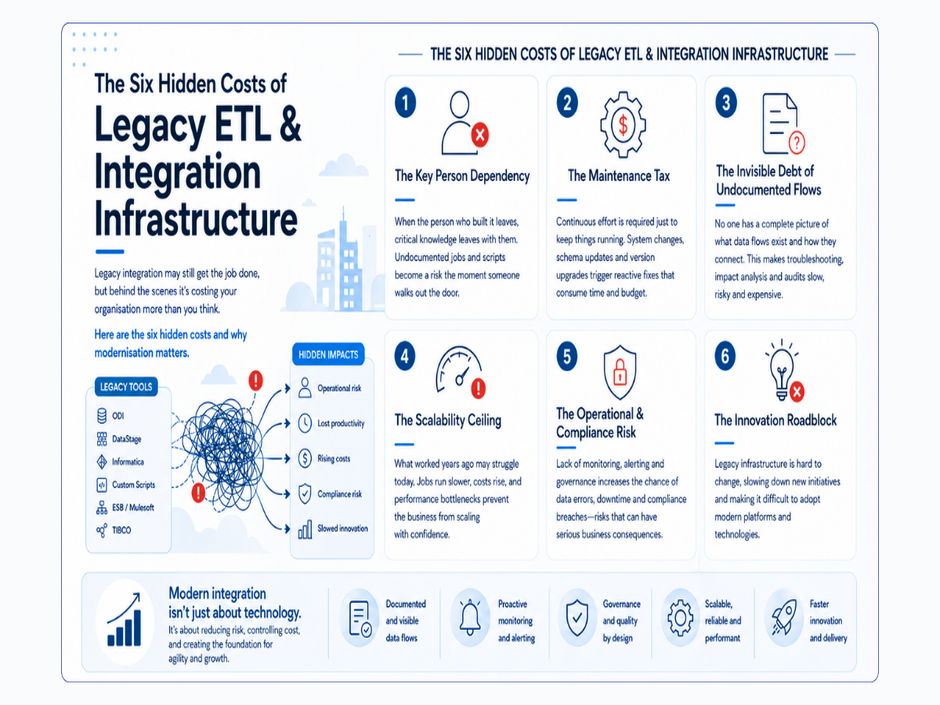
There is another reason it stays hidden. In most organisations, integrations are owned by nobody in particular. They were built by a developer who has since left, or a vendor who delivered the project and moved on, or an internal team that has since been restructured. The knowledge of how they work, what they depend on, and what breaks them lives in someone's head — or in no head at all.
This is what we call the integration ownership gap. And it is one of the most common conditions we find in organisations that have been growing steadily for five or more years.
The Five Warning Signs
You do not need a formal assessment to get a rough sense of whether your organisation has an integration risk problem. These five warning signs are worth paying attention to.
1. You find out about integration failures when someone complains
If your team discovers that a data feed has been broken for three days because a business user noticed something wrong in a report — rather than because a monitoring system alerted you — that is a sign your integrations are not adequately observed or owned.
A practical example: a finance team at a mid-sized accounting firm noticed that client billing data in their reporting tool was two weeks out of date. When they investigated, they found that the integration between their practice management system and their data platform had silently stopped running after a software update. Nobody had been alerted. The data had simply stopped flowing.
2. Your reports tell different stories depending on which system you look at
When two systems that are supposed to share the same data disagree on the numbers, it is almost always an integration problem. Data is being transformed differently at different points, or it is not being synchronised frequently enough, or there is a timing mismatch between systems.
A practical example: a mining company's operations dashboard showed a different headcount to the HR system it was supposed to reflect. The discrepancy was traced to a batch integration that ran once a day and did not handle contractor records the same way each system did. The operations team had been making resourcing decisions based on inaccurate numbers for months.
3. Manual data entry or reconciliation is a regular part of someone's job
When people are manually copying data between systems, or spending time reconciling figures that should already match, it is a sign that the integrations between those systems are either broken, missing, or not trusted. Manual workarounds are always a symptom — they exist because the automated connection failed or was never built properly in the first place.
A practical example: a state government department had three staff members spending half a day each week manually reconciling compliance data across two systems because the integration between them produced inconsistent results. The manual process had been in place for so long that it had become accepted as normal.
4. System updates regularly break something else
When your CRM releases a new version and suddenly your reporting tool stops updating, or your HR platform changes its API and your payroll integration breaks — that is a sign your integrations are brittle and not being actively maintained.
Modern SaaS platforms release updates frequently. APIs change. Data schemas evolve. An integration that is not actively owned and maintained will eventually break when the platform it connects to changes underneath it. If your team dreads software updates because of what they might break, that is a meaningful signal.
5. Nobody can tell you exactly what your integrations are or how they work
Ask someone in your organisation to give you a complete list of your business-critical integrations — every system connection, what data flows between them, how often, and who is responsible if one breaks. If the answer is uncertain, incomplete, or involves finding a specific person who might know — that is the integration ownership gap in plain sight.
The Business Impact
Integration risk is not just a technology problem. It has direct business consequences.
Compliance and audit exposure. In regulated industries — education, government, financial services, mining — data accuracy and traceability are not optional. If your compliance reports are fed by integrations that are fragile or undocumented, your audit trail has gaps you may not even be aware of.
Decision-making on unreliable data. Executives and managers make decisions based on the data in front of them. If that data is arriving late, being transformed incorrectly, or simply not flowing at all, those decisions are being made on an inaccurate picture. The cost of that is difficult to measure but very real.
Operational disruption. When a business-critical integration breaks — payroll, billing, student enrolment, loan processing — the operational impact is immediate. Staff spend time on manual workarounds, errors are introduced, and the team that should be running the business is instead troubleshooting a data pipeline.
Reputational exposure. For professional services firms and government agencies, data errors that reach clients or the public carry reputational consequences that go well beyond the immediate operational impact.
What Good Looks Like
Organisations with well-managed integration environments share a few common characteristics.
Every integration is documented and owned. There is a named person or team responsible for each connection, and that responsibility does not disappear when a project ends.
Integrations are monitored. When something breaks or behaves unexpectedly, an alert fires before a business user notices. The team finds out about failures — not the other way around.
Changes are managed. When a source system releases an update, the integration team knows about it in advance, tests the impact, and deploys a fix before anything reaches production.
The platform is governed. Data flows through a structured environment — not a collection of scripts and point-to-point connections that only one person understands.
Most mid-sized organisations are not there yet. The good news is that getting there does not require rebuilding everything at once. It starts with understanding where you actually are.
The Connection to AI Readiness
Integration risk is increasingly relevant in the context of AI. Every credible AI initiative — whether it involves predictive analytics, automated reporting, or machine learning — depends on a reliable, governed flow of accurate data.
AI models do not tolerate bad data. If your integrations are fragile, your pipelines are inconsistent, and your data cannot be trusted, any AI capability built on top of them will reflect those problems directly in its outputs. Organisations that want to use AI meaningfully need to resolve their integration risk first.
In this sense, addressing integration risk is not just an operational imperative — it is the prerequisite for everything your business wants to do next with data and technology.
What To Do Next
The first step for most organisations is simply getting a clear picture of what they have.
That means mapping your integrations, understanding which are business-critical, identifying who owns them, and assessing how fragile they are. Done properly, this exercise surfaces the gaps that have been quietly accumulating and gives your leadership team a basis for making informed decisions about where to invest.
This is exactly what our Data and Integration Risk Assessment is designed to do — in a fixed timeframe, at a fixed price, without the open-ended engagement that traditional consulting typically involves.
If any of the warning signs in this article felt familiar, it is worth having a conversation.
Cypher Agency is a boutique data and integration engineering firm helping mid-sized Australian businesses build reliable, governed data and integration environments — without the cost of building an internal team.

Comments