
AI Data Sovereignty: Where Does Your Data Go When It Passes Through an AI Model?
Disclaimer: This article is provided for general informational purposes only and does not constitute legal advice. While the legislative references in this article have been verified against primary source documents, laws, agreements, and vendor practices in this area change frequently. Organisations should seek advice from a qualified legal professional regarding their specific circumstances and compliance obligations before making decisions based on this content.
Most organisations adopting AI assistants and agents have already answered the residency question that used to matter most: which region does our cloud data live in? For many, the answer is Australia — a Sydney or Melbourne data centre, ticked off as a compliance requirement.
AI adoption quietly reopens that question in a form most governance frameworks were never built to handle. The moment a staff member types a prompt into an AI assistant, or an AI feature embedded in an existing platform activates in the background, data can begin moving through infrastructure, vendors, and jurisdictions that sit outside the boundaries an organisation carefully defined for its core systems.
This is the essence of AI data sovereignty: not simply where your data is stored, but where it goes, who can access it, and under whose law, at the moment it touches an AI model.
What Is AI Data Sovereignty?
Data sovereignty, in its traditional sense, concerns the legal jurisdiction governing data based on where it is physically stored. AI data sovereignty extends that concept to a faster-moving and less visible layer: the flow of data into, through, and sometimes
beyond an AI model at the point of use.
This distinction matters because AI introduces data flows that infrastructure-level residency controls do not fully address. An organisation can have a fully compliant, Australian-resident data platform and still lose visibility and control the moment an AI feature is switched on, because AI adoption creates new pathways for data to travel that existing governance frameworks were not designed to capture.
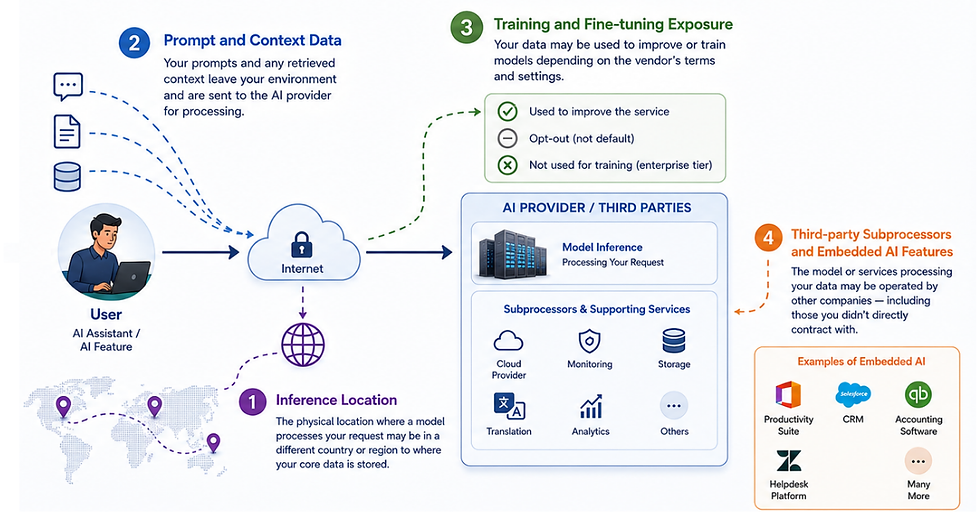
Four Places AI Adoption Creates New Data Exposure
1. Inference location. The physical location where a model actually processes a request does not always match the location where an organisation's core data is stored. A chat assistant, coding tool, or embedded AI feature may route a request to infrastructure in a different country entirely, independent of where the underlying business data platform sits.
2. Prompt and context data. Every time a user submits a prompt, or an AI feature retrieves supporting context a document, a database record, an embedding - that content leaves the organisation's controlled environment and is transmitted to the AI provider's infrastructure for processing. This is frequently the largest and least monitored data flow introduced by AI adoption.
3. Training and fine-tuning exposure. Vendor terms vary on whether submitted data may be used to improve or train underlying models, and whether this is enabled by default, opt-out, or excluded entirely for enterprise tiers. This is a critical, and frequently overlooked, point of due diligence before AI adoption at scale.
4. Third-party subprocessors and embedded AI features. An organisation may have contracted directly with one AI vendor, while the actual model performing inference is operated by a separate company entirely. AI features embedded inside existing SaaS platforms - productivity suites, CRM systems, accounting software can introduce additional subprocessors an organisation never directly evaluated or contracted with.
Why This Matters for Regulated Australian Organisations
For non-bank lenders and wealth managers, data handling practices sit within the scope of prudential expectations around outsourcing and offshoring arrangements, including the standards APRA applies to regulated entities. For government agencies, existing data handling directives and Machinery of Government requirements were built around infrastructure-level residency, not AI-specific data flows. For universities and education providers, research data, international student records, and funding body obligations frequently carry their own layered requirements.
None of these frameworks were designed with AI-specific data movement in mind - which is precisely why AI adoption requires a fresh, deliberate assessment rather than an assumption that existing data governance already covers it.
A concrete example: the US CLOUD Act. Major AI and cloud providers, including the largest AI model providers are headquartered in the United States. Under the US CLOUD Act (2018), which amended the Stored Communications Act by adding 18 U.S.C. §2713, a provider must disclose the contents of a communication and related records "within such provider's possession, custody, or control, regardless of whether such communication, record, or other information is located within or outside of the United States." In practice, this means US authorities can, through appropriate legal process, compel a US-headquartered provider to produce data it controls, irrespective of where that data is physically stored. Selecting an Australian data centre region controls data residency; it does not, on its own, remove a US-headquartered provider from US legal jurisdiction.
The Act does include a check on this power: under the comity provision at 18 U.S.C. §2703(h), a provider can move to quash or modify an order where the customer is not a US person, does not reside in the US, and disclosure would create a material risk of violating a qualifying foreign government's law - with a court weighing factors including the customer's location and nationality and the provider's ties to the US. This narrows, but does not eliminate, the Act's reach.
Australia and the United States have also established a bilateral framework - the Australia-US CLOUD Act Agreement, signed in Washington on 15 December 2021 - which streamlines how each country's agencies can request data directly from providers in the other country. Under Article 1.15 of the Agreement, requests are limited to a "Serious Crime," defined as an offense punishable by a maximum term of imprisonment of at least three years. Article 4.3 prohibits either country from intentionally targeting the other's citizens, permanent residents, or persons located in its territory, and Article 5.2 requires orders to be subject to review or oversight by a court, judge, magistrate, or other independent authority under the issuing country's domestic law. This is a separate, complementary mechanism to the underlying US law, not a replacement for it.
This is offered as a factual illustration of how legislative reach and data residency can diverge - not as legal advice. Organisations with specific compliance obligations should confirm current requirements with qualified legal counsel.
An Australian Practitioner's Perspective: Procurement Isolation and Unmanaged Risk
Working across Queensland State Government agencies, and with multinational enterprises operating audit, banking, and financial services functions in Australia, a consistent pattern emerges: technology procurement and data governance are run as separate, disconnected processes.
Procurement functions are typically well-equipped to evaluate price, contractual terms, functional fit, and a standard information security questionnaire. What they are rarely equipped or mandated to evaluate is data sovereignty and AI-specific data flow risk as a formal, quantified component of the acquisition decision - particularly where AI capability arrives bundled inside a broader SaaS platform rather than being procured as a discrete, named decision.
The consequence is not that these risks are deliberately accepted. It is that they are never quantified in the first place. A technology acquisition proceeds through procurement governance, is signed off, and goes live - while the jurisdictional exposure, subprocessor relationships, and legislative frameworks it introduces sit outside both the procurement record and the enterprise risk register. The risk exists, but no one owns it, tracks it, or has measured its scale. It typically only surfaces later, during an internal audit, a client due diligence request, an incident, or a regulatory inquiry - at which point remediation is considerably more expensive than prevention would have been.
This pattern holds regardless of organisation size or sector. Large, sophisticated enterprises with mature procurement governance are just as susceptible as smaller organisations, because the gap is structural rather than a matter of process maturity: procurement was designed to answer commercial and functional questions, not AI-specific data sovereignty questions, and no one has yet redesigned the gate to ask them.
Closing this gap does not require a separate approval process bolted on top of procurement. It requires data sovereignty and AI data flow exposure to be built into the existing acquisition gate as a standard, quantified line item - assessed with the same rigour as cost and functional fit, before a technology decision is finalised rather than discovered afterwards.
The Silent Risk: AI Features You Didn't Procure
The exposure that catches most organisations off guard is not the AI tool they deliberately adopted - it is the one that arrived by default. Productivity suites, CRM platforms, and accounting software are increasingly shipping AI-assisted features as standard, sometimes enabled automatically as part of a routine update.
These features can quietly introduce new data flows and new subprocessors without ever appearing on a procurement register or a vendor risk assessment, simply because no one made an active decision to adopt them. An organisation's AI governance is only as complete as its visibility into every AI feature actually running across its technology estate - not just the ones it consciously chose.
What Governed AI Adoption Looks Like in Practice
Addressing AI data sovereignty does not require halting AI adoption. It requires treating AI data flows as a distinct, deliberately governed category rather than an extension of existing data governance by assumption. In practice, this involves:
Data classification before AI exposure: Understanding which data categories (client information, personal information, commercially sensitive data) are permitted to reach AI services, and which are not
Explicit allow-lists: Defining which AI services and features specific data categories may be exposed to, rather than leaving this to individual user discretion
Contractual and vendor review: Examining subprocessor arrangements, training-use terms, and data retention policies for every AI service in use, including those embedded within existing platforms
Logging and audit of AI data flows: Extending existing data lineage and access control practices to cover AI-specific data movement
Ongoing monitoring, not a one-off review: AI features and vendor terms change frequently; governance needs to be a continuing operational discipline rather than a single assessment
This is the practical meaning of AI-accelerated, governance-first engineering: adopting AI capability without losing sight of where data actually goes and building the architecture and processes that keep that visibility current as both the AI landscape and the organisation's technology estate evolve.
The Question Worth Asking
Most organisations can answer, with confidence, which region their core data platform sits in. Fewer can answer the equivalent question for AI: which services does our data actually reach, what do those services' terms permit, and which jurisdictions and legislative frameworks apply as a result.
That gap is not a sign of poor governance. It is a sign that AI adoption has moved faster than the frameworks built to govern it - and that data sovereignty, once a solved infrastructure question, is once again an open one.
This article was written by Keith Jenneke, Principal Consultant at Cypher Agency. Keith leads Cypher's Data, Integration, and AI Engineering practice, building governed Modern Data Platforms that make data reliable, integrated, and analytics- and AI-ready, delivered across professional services, resources, and government sectors in Australia.


Comments